






When an IT project needs to move quickly, hiring is often the slowest part of the plan. A business may need cloud engineers for a migration, developers for a product release, or security specialists for an audit. But finding and onboarding permanent employees can take months. During that time, deadlines slip, existing teams take on more work, and important projects lose momentum.
When a high-stakes engineering project falls behind schedule, the immediate reflex is to open a requisition for full-time hires. Then reality sets in. Between drafting job descriptions, screening resumes, surviving four rounds of technical interviews, and waiting out a 60-day notice period, your team is stuck in hiring queues for months. Meanwhile, your core architects are working 60-hour weeks to plug the gaps, sprint velocity drops, and your product launch date slips.
IFI Techsolutions helps businesses solve this problem through IT staff augmentation. Instead of waiting months to complete permanent hiring, companies can add skilled professionals to their existing teams for a specific project, skill gap, or period of high demand. For example, a company planning an Azure migration may already have an internal project manager but lack an Azure architect. Instead of delaying the work or hiring someone for a role that may not be permanent, the company can add the required specialist for the migration and scale back once the project is complete.
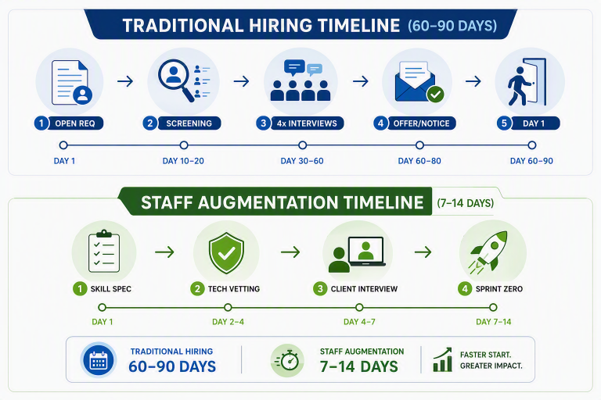
The Reality of IT Staff Augmentation: What It Actually Means for Engineering Leaders
Staff augmentation is simple in theory: you manage the project, set the priorities, and review the pull requests. The partner provides the technical talent to execute the work. The external engineers use your repositories, join your daily standups, pull tickets from your Jira boards, and deploy through your CI/CD pipelines. They act as a direct extension of your existing team, not an external black box
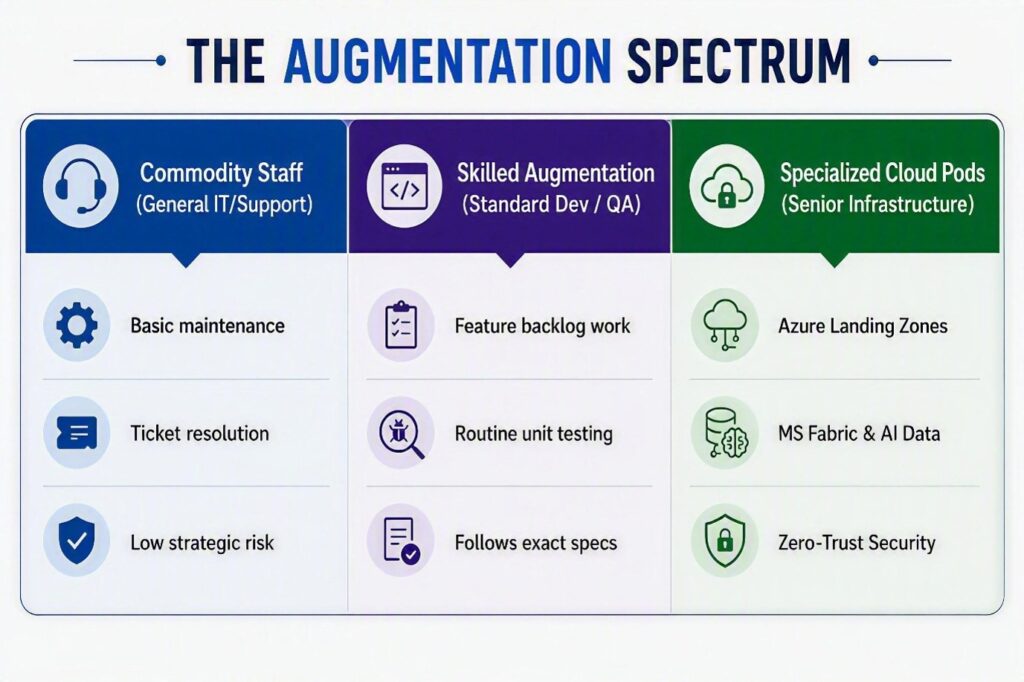
Commodity Staffing vs. Specialized Cloud Augmentation
There is a major difference between simply filling an empty seat and adding real technical expertise to your team.
The market is full of agencies that treat IT staffing like a numbers game, passing off junior developers with basic certifications as senior engineers. If you are migrating to Azure or building complex data pipelines in Microsoft Fabric, this type of cheap labor quickly becomes very expensive. An unqualified contractor will ultimately cost you triple their hourly rate in project delays, broken code, and the time your internal team spends redoing their work.
To protect your project, watch out for these 5 red flags that an agency is selling you junior talent:
- No direct interviews: They refuse to let your internal tech leads conduct the final interview with the developer.
- Resume dumping: They flood your inbox with 15 random resumes instead of sending 2 thoroughly vetted experts.
- No real-world experience: Their engineers might know the theory, but they cannot explain how they handled real deployment issues or system failures in past projects.
- Loss of control: They push for a “hands-off” model where they manage the developers, taking away your daily project control.
- No industry credentials: They lack verified, top-tier vendor partnerships (such as Microsoft Solutions Partner status).
Ready to get started?
Scale Your IT Team. Not Your Hiring Delays!
Why Scaling IT Teams Has Become More Challenging
Specialized skills are difficult to find
Modern technology projects rarely depend on one type of professional. An Azure migration may involve cloud architects, infrastructure engineers, database specialists, security experts, and DevOps professionals. A data project may require experience in Microsoft Fabric, Power BI, data engineering, and AI. Businesses across different industries compete for many of the same skills. This can make specialized positions harder to fill through standard recruitment.Hiring cannot always keep pace
Technology initiatives often have fixed deadlines. A product release, cloud migration, customer commitment, or regulatory requirement cannot always wait for a long recruitment process. Finding candidates, arranging interviews, negotiating an offer, and completing onboarding can take weeks or months. Even after a candidate accepts, a notice period may delay the joining date. In many cases, the required expertise is available. The real difficulty is getting that expertise into the team when it is needed.
Project requirements keep changing
Technology workloads are rarely consistent. A team may need additional developers before a release, more security support during an audit, or cloud engineers throughout a migration. Hiring permanent employees for every increase in workload can raise long-term costs. Moving current employees between projects may not work either, especially when they are already managing important responsibilities. The challenge is therefore not simply hiring more people. It is finding a way to adjust team capacity as business needs change.The Financial Math: Hourly Contract Rates vs. The Fully Burdened Cost of Inaction
The cost of an employee or external professional is easy to see. The cost of leaving a position open is harder to calculate. A delayed cloud migration may postpone expected savings. A missing security specialist may hold up a compliance initiative. A shortage of developers may force a product team to remove valuable features from a release. Unfilled roles can also affect current employees. Team members may work longer hours, switch between too many tasks, or rely on short-term fixes. Over time, this can reduce quality, increase technical debt, and contribute to burnout.
[ FULL-TIME HIRE OVERHEAD]
Base Salary ($140k) + 28% Benefits ($39k) + $25k Recruiter Fee + 60-Day Ramp Lag
= Massive upfront fixed cost before a single line of code is written.
VS.
[ AUGMENTED CONTRACTOR]
All-Inclusive Hourly Rate X Actual Sprint Months Needed
= Zero placement fees, zero benefits overhead, instant scale-down when done.
The Hidden Management Overhead
Contractors are not plug-and-play magic. Let’s address the ugly side of onboarding. Your senior engineers will lose 15–20% of their velocity during the first two sprints reviewing contractor PRs, explaining legacy spaghetti code, and setting up environments. Budget for this hit up front, or your sprint goals will blow up.Ready to get started?
Close Skill Gaps. Keep Critical Projects Moving.
IT Staff Augmentation Strategy vs. Managed Services vs. Outsourcing
Staff augmentation charges variable hourly rates for direct team capacity while the client retains 100% architectural control. Managed services charge fixed monthly fees for operational uptime where the vendor owns delivery. Project outsourcing charges milestone-based pricing where the vendor owns the end-to-end outcome.
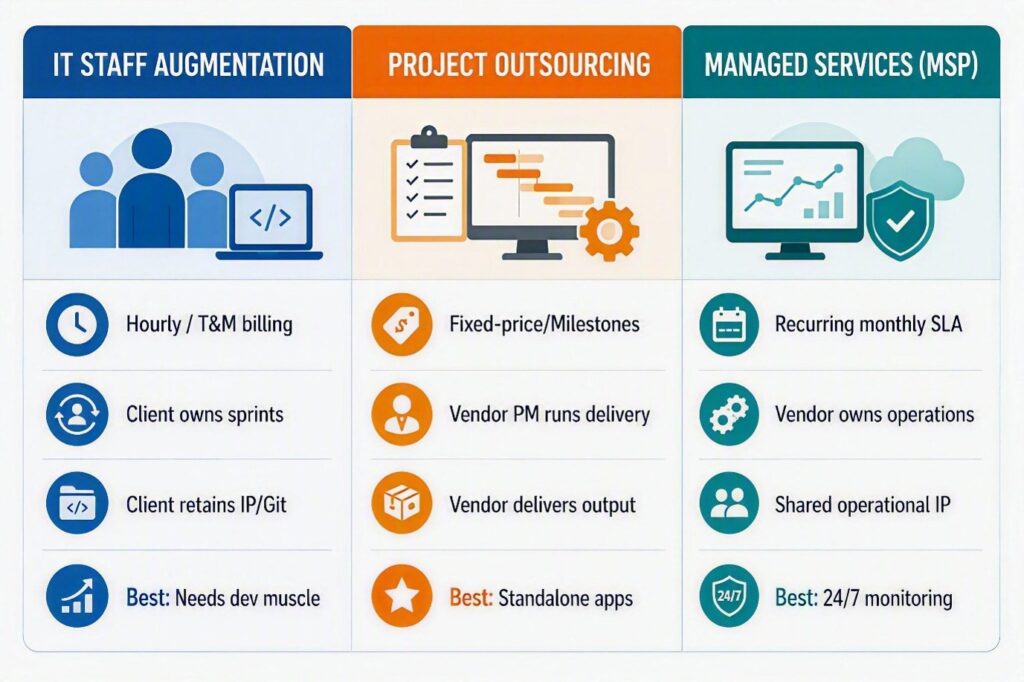
Staff Augmentation vs. Traditional Hiring
| Area | Traditional hiring | Staff augmentation |
| Best suited for | Permanent core roles | Temporary or specialist needs |
| Time to add capacity | Usually longer | Often shorter |
| Commitment | Long term | Based on the engagement |
| Ability to scale | Requires further hiring | Capacity can be adjusted |
| Daily management | Client | Client |
| Knowledge retention | Stronger over time | Needs a transfer plan |
Ready to get started?
Get the Right IT Experts Without the Long Hiring Cycle!
The Operational Friction: Addressing the Real Challenges of Augmented Developers
Let’s cut through the agency sales pitch: managing remote contractors is difficult. You must enforce minimum working overlap and treat external developers like direct members of your team, not an isolated unit.
Time-Zone Exhaustion and Code Quality Drift
The promise that “they build while you sleep” is a myth for active product development. A single ambiguous Jira ticket stops work for 24 hours while the contractor waits for an answer. Mandate at least 4 hours of real-time working overlap with your technical leads for pair programming, standups, and instant Slack unblocking.
[ ASYNC BOTTLENECK CYCLE – ZERO OVERLAP]
Lead posts PR feedback ──> 8-Hour Delay ──> Dev reads feedback ──> 14-Hour Delay
Result: 24+ hours lost on a single code review comment.
Furthermore, when contractors are incentivized by ticket volume instead of code quality, your internal tech leads get buried in gruelling PR reviews.
Automated PR Quality Gates to Enforce on Day 1:
- Block direct commits to the main branch.
- Require passing static code analysis (e.g., SonarQube).
- Mandate a minimum 80% automated unit-test coverage on all new code.
- Require at least one internal senior engineer sign-off before merge.
Technical Execution: Embedding External Muscle into High-Stakes Enterprise Stacks
Successful staff augmentation in enterprise environments requires embedding specialists directly into existing Azure DevOps CI/CD pipelines, Git repositories, and automated governance frameworks. External engineers must work within the client’s existing architecture, branch policies, and data security perimeters.
True staff augmentation is not about writing isolated code in a sandbox. It is about injecting engineers directly into your active repositories without breaking existing architecture.
[ VENDOR TALENT SOURCING] ──> [ ENTRA ID IDENTITY PROVISIONING] ──>
[ AZURE DEVOPS PIPELINE ASSIGNMENT] ──> [ AUTOMATED GATE EXECUTION] ──> [ PRODUCTION]
Azure DevOps, Microsoft Fabric, and Dynamics 365 Sprints
Never hand contractors raw production credentials. Use Azure DevOps branch policies, mandatory multi-reviewer PR requirements, and ephemeral deployment environments so contractors can build and test without ever touching live infrastructure. Use Azure Managed Identities for pipeline execution. Developers push code; the pipeline pushes to production.
Data engineering augmentation is dangerous if the contractor doesn’t understand your specific data governance rules. Have augmented engineers focus on building bronze layer API connectors and silver layer transformation notebooks. Keep Gold layer semantic models and Power BI governance strictly in-house.
Finally, Dynamics 365 migrations stall when internal teams get bogged down supporting legacy on-prem versions while trying to build the target cloud state. Use augmented Dynamics specialists for the heavy lift of data mapping, custom entity refactoring, and Power Platform automation. Free your internal core team to own final integration and acceptance testing.
Security, Compliance, and Intellectual Property: Bullet proofing Your Source Code
Enterprise-grade IT staff augmentation requires strict IP assignment agreements, non-disclosure contracts, and Zero-Trust access controls before code is written. Companies use role-based access control, Just-In-Time access via Entra ID, and cloud virtual desktops to ensure source code never resides on unmanaged personal hardware.
If your legal team hasn’t locked down absolute, work-for-hire IP assignment before an augmented developer writes their first function, you are building technical equity on rented land. External professionals should follow the same access and governance policies as permanent employees. Permissions should be limited to the requirements of each role and removed when the engagement ends.
Zero-Trust Access, Entra ID (Azure AD), and Virtual Workstations
Stop letting remote contractors clone your core Git repos onto unmanaged local machines.
[ Contractor Endpoint] ──> [ MFA / Conditional Access] ──>
[ Azure Virtual Desktop / Code spaces] ──> [ Internal Repos & DBs]
The Threat & Mitigation Matrix:
| Threat Vector | Technical Guardrail | Contractual Control |
| IP Theft | Block local disk mapping and USB transfers | Explicit Work-for-Hire clauses in Master Services Agreement. |
| Data Leakage | Enforce development inside Azure Virtual Desktop | Immediate termination clauses for bypassing AVD. |
| Credential Exposure | Use Azure Key Vault; block raw secret access | NDA and strict SOC2/ISO 27001 compliance mandates. |
| Excessive Access | Entra ID Privileged Identity Management (PIM) | Time-bound, Just-In-Time (JIT) access approvals. |
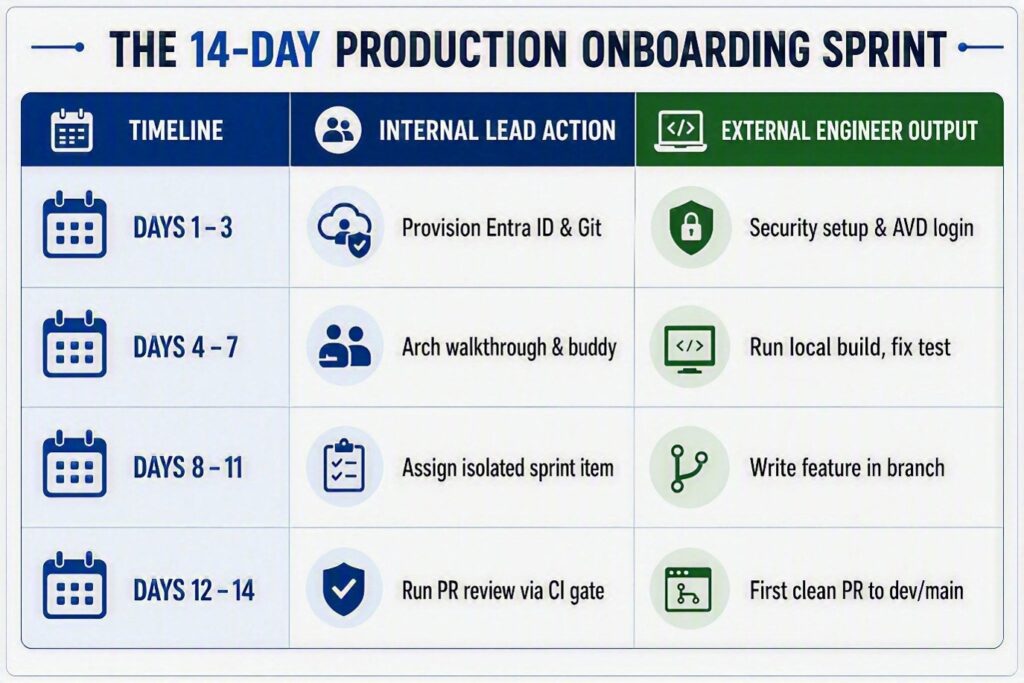
The 14-Day Engineering Onboarding Playbook
A production-ready staff augmentation onboarding process takes under 14 business days, moving from identity provisioning in Days 1–3 to architecture immersion in Days 4–7, and culminating in a merged production PR by Day 14. This requires automated environment scripts, pre-assigned Jira epics, and a dedicated internal buddy.
If your external engineers aren’t committing code by the end of their second week, your onboarding process is broken. Cut the administrative drag. Prepare your identity groups, AVD images, and a curated “good-first issue” backlog before the contractor logs in.
Prepare the Working Environment and Set Expectations
System access, project documents, architecture information, and current priorities should be ready before the start date. Assign an internal contact who can answer questions during onboarding.
Agree on meeting schedules, working hours, progress updates, documentation, technical reviews, and escalation paths. Everyone contributing to the same project should follow consistent quality standards. Documentation should be produced throughout the engagement. Important decisions, configurations, processes, and unresolved issues must remain available to the internal team after the professional leaves.
Ready to get started?
Build a Stronger IT Team. Accelerate Business Growth!
How to Evaluate an IT Staff Augmentation Partner
Evaluating a staff augmentation partner requires assessing technical vetting depth, replacement turnaround SLAs, and verified ecosystem certifications rather than resume volume. Engineering leaders look for partners offering direct client technical interviews, minimum working overlap guarantees, and a no-risk trial period.
A suitable partner should understand the technical requirement and how the professional will fit into the existing team. Ask the provider how technical and communication skills are assessed, if the client can interview candidates, and what happens if a professional is not the right fit.
Never let an account executive send you a blind batch of 20 resumes scraped from job boards. A high-tier partner acts as a technical filter, presenting 2–3 pre-vetted engineers who have already passed real-world coding benchmarks. If they won’t let you conduct the final technical interview, walk away.
The 8 Non-Negotiables Scorecard:
- Direct Interview Access: Do in-house engineers conduct live technical interviews?
- Overlap Guarantee: Is there a minimum 4-hour working overlap?
- Replacement SLA: Is there a 10-day replacement policy for poor fits?
- Stack Certification: Are engineers certified in your target stack (e.g., Azure)?
- Partner Status: Does the firm maintain active partner credentials (e.g., Azure Expert MSP)?
- Legal Protection: Is IP assignment explicitly protected in the MSA?
- Elasticity: Can capacity scale up or down with 30 days’ notice?
- Workflow Alignment: Are engineers experienced in modern CI/CD and Git flows?
Why Choose IFI Techsolutions?
IFI Techsolutions helps businesses extend their IT teams with professionals across cloud, data, AI, security, application development, DevOps, Microsoft 365, Power Platform, and Dynamics 365. Our professionals work within the client’s tools, processes, and delivery structure. The client retains control over priorities and day-to-day direction while gaining the additional expertise required to move important work forward.
We take the 8 non-negotiable questions outlined above very seriously. In fact, our engagement model is explicitly built to solve every single one of them. From guaranteeing direct interview access and minimum working overlap to enforcing strict intellectual property protection, we ensure a secure and transparent partnership.
As a Microsoft Solutions Partner and Azure Expert Managed Service Provider founded by former Microsoft executives, IFI Techsolutions brings practical experience across Microsoft technology environments. We match professionals to actual project requirements rather than relying only on keywords in a resume. Businesses can engage an individual specialist, a dedicated team, or project-specific resources based on their needs.
Conclusion
Scaling an IT team is not simply about adding more people. It is about gaining the right skills when a project needs them. Staff augmentation helps businesses address temporary capacity requirements, fill specialist gaps, and support urgent work while retaining control. It works best when internal leadership is already in place and the company has a clear understanding of the work to be completed.
Don’t let lengthy recruitment cycles dictate your product roadmap. By treating augmented engineers as direct extensions of your team, enforcing strong CI/CD guardrails, and demanding zero-trust security architecture, you can scale your sprint capacity in days instead of months. With careful selection, structured onboarding, proper security controls, and early knowledge-transfer planning, augmented professionals can become a valuable extension of the internal team.
Ready to get started?
The Right IT Talent. Ready When You Need It!
Frequently Asked Questions
What is IT staff augmentation?
IT staff augmentation allows a business to add external technology professionals to its existing team for a project, skill gap, or temporary capacity need. The client manages the work and retains control over priorities, technical decisions, and delivery. The provider supports candidate sourcing, evaluation, and engagement administration.
How is staff augmentation different from outsourcing?
Staff augmentation provides people who join a client-managed team. The client assigns responsibilities and remains accountable for the project. With outsourcing, the provider manages the delivery team and takes responsibility for completing an agreed scope. One model adds capacity, while the other transfers project ownership.
Who manages augmented professionals?
The client manages their daily work. Augmented professionals normally report to the client’s project manager, engineering lead, or department head. The provider may handle administrative support, but the client controls task allocation, technical direction, priorities, and quality reviews.
How quickly can augmented professionals join?
The timeline depends on the role, availability, interview process, contract requirements, and system access. A provider with an existing network of assessed professionals may reduce sourcing time, but the exact joining time should only be confirmed after the requirements have been reviewed.
Is staff augmentation suitable for long-term work?
It can support short and long engagements. However, businesses should review longer arrangements regularly. If a role becomes permanent and central to the organization, direct hiring may provide better continuity and long-term knowledge retention.
How can businesses protect their data?
Use confidentiality and intellectual property agreements, grant access based on job responsibilities, review permissions regularly, and remove access when the engagement ends. External professionals should follow the same security, data handling, and governance requirements as internal employees.